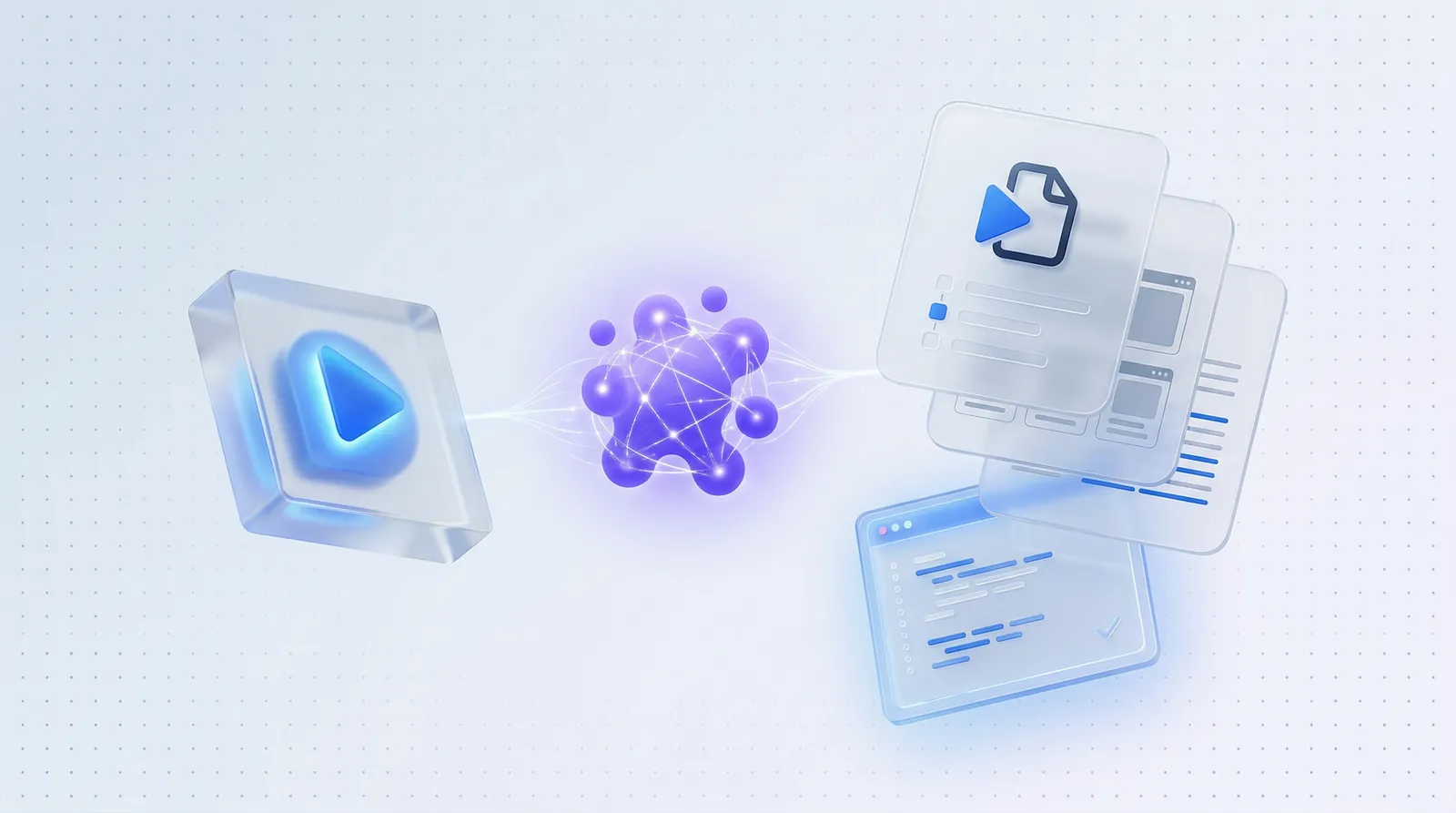
Most teams record app walkthroughs for onboarding or QA, then let them collect dust. But those recordings hold something you're not using: a map of how your application actually works.
When you turn a screen recording into documentation and feed that structured walkthrough to an AI model, you're giving it real context about how your app works. It goes from being a generic coding assistant to one that understands your product.
Why Screen Recordings Beat Written Docs
Written documentation goes stale the moment you ship a new feature. Screen recordings capture the current state of your app, including the flows, the edge cases, and the visual context that written docs always miss.
ReplayDoc extracts this into structured markdown with screenshots at every step. That output is something an AI can actually consume and reason about.
Your AI can read code. It can't see your app. A screen recording closes that gap.
What to Record (and How Long)
Not all recordings are equally useful. Here's what gets the best results:
- Core user flows: Signup, onboarding, the main action your app enables, and checkout or conversion. These are the flows your AI will be asked about most.
- Navigation paths: Click through your sidebar, menus, and settings. This gives the AI a mental model of where things live.
- Edge cases: Error states, empty states, loading states. These are the screens written docs skip but that generate the most bugs.
- Integrations: If your app connects to third-party tools, record those flows too. The AI needs to know what happens at the boundaries.
Keep each recording under 5 minutes. Record one flow per video. A set of 3-4 focused recordings covers more ground than one 20-minute ramble.
The Screen Recording to Documentation Pipeline
Here's how to go from a raw screen recording to an AI coding assistant that knows your app:
Step 1: Record Your App Flow
Open your screen recorder and walk through the key flows in your app. Don't script it. Just use the app naturally, the way a real user would. Click through forms, navigate between pages, trigger error states.
The goal isn't a polished demo. It's a faithful capture of how the app actually works.
Step 2: Extract with ReplayDoc
Upload the recording to ReplayDoc. The AI analyzes every frame, identifies each distinct step, captures screenshots at the right moments, and generates structured markdown documentation.
What you get back:
- Each step gets a clear description of what happened
- Screenshots are captured when the result is visible, not when the action starts
- The full flow is ordered chronologically
- Export as a ZIP with markdown and all screenshots
Step 3: Feed It to Your AI
Take the exported ZIP and add it to your AI's context. Whether you're using Claude Code, Codex, Cursor, or Gemini, the structured markdown with inline screenshots gives the model a clear picture of how your app works.
Now when you ask it to "add a confirmation step to the checkout flow," it knows exactly what the checkout flow looks like, what screens are involved, and where the confirmation should go.
What Changes When Your AI Has Real App Context
Without a walkthrough, your AI generates generic code. With one, it generates code that fits.
Without context: "Add a confirmation modal to the checkout flow." The AI generates a generic modal component with placeholder text, a random color scheme, and no connection to your existing UI.
With walkthrough context: Same prompt.
The AI references your existing Button component, matches your color variables, places the modal after the payment step it saw in the walkthrough, and uses the same toast notification pattern from your other flows.
Same prompt, completely different output. The only variable is the context you gave it.
The walkthrough is useful beyond code, too. AI can extract your existing UI patterns from the screenshots and stay consistent when generating new screens. You can hand it to AI and ask it to find UX friction in the flow. The walkthrough already is step-by-step onboarding documentation that matches the current app state. AI can generate test cases that cover real user journeys, not just happy paths. And you can export it as a structured SOP and feed it directly to an agent framework.
Getting Started
Record a 2-minute walkthrough of your app's most important flow. Upload it to ReplayDoc. Download the export. Drop it into your AI assistant's context. Ask it a question about your app.
The gap between a generic AI response and one that understands your product is the documentation you give it. A screen recording captures what written docs miss: what your app actually looks like when someone uses it.